
World Interbeing Sangha
Practicing mindfulness and Engaged Buddhism in the tradition of
Zen Master Thích Nhất Hạnh
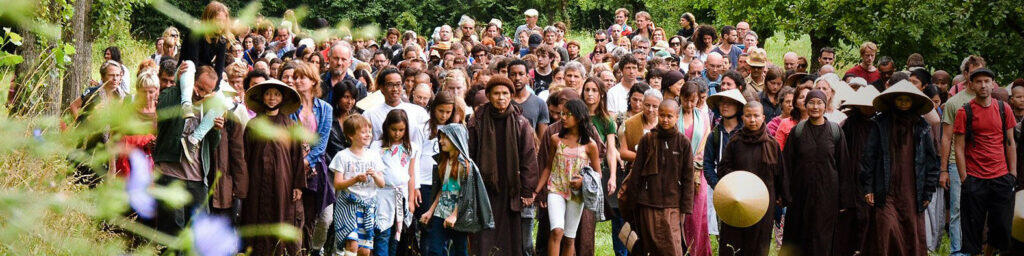
A most important part of sangha building is to flow with the sangha as one river, and not to behave as a drop of water outside of the river.
– Thich Nhat Hanh
We are a global online community, diverse and inclusive, welcoming all people and all parts of all people. Our sangha offers meetings each week at different times, so people from different time zones can find one that fits.
Who We Are → our lineage, our practice, and what Engaged Buddhism means to us.
Ready to join us?To join, please submit a short request below — a few words about yourself and your interest in practicing with a sangha in the Plum Village tradition. We ask this to keep our community focused on genuine practice, not commercial interest, and this information is never shared.Once reviewed, you'll be added to our mailing list (via Google Groups — no Google account needed) and start receiving invitations to our meetings, held on Zoom.
Thank you.
Your message has been received, and someone from our Care Taking Council will be in touch soon. 🙏
← Back to homepage
Who we are.
World Interbeing Sangha is a global online community practicing mindfulness and Engaged Buddhism in the Plum Village tradition of Zen Master Thich Nhat Hanh.We are a diverse and inclusive community that welcomes all people and all parts of all people.Our sangha offers [several meetings each week](link to Our Meetings) at different times, so people from different time zones can find one that fits.
Our Lineage
Plum Village in France is the first monastic practice center founded by Thich Nhat Hanh in the West. It's where he developed the light, gentle style of mindfulness practice now familiar around the world.While mindfulness is often seen as a stress-relief technique, Thich Nhat Hanh taught it as a way of life — something applied not just to sitting, but to walking, eating, speaking, listening, and working.
The Five Mindfulness Trainings
The Plum Village tradition uses the Five Mindfulness Trainings — a concrete expression of Buddhist teachings that brings an ethical and spiritual dimension to how we live and decide. They're a compass, not a rulebook.
Why Community
Applying mindfulness to daily life isn't always easy. With the support of a spiritual community — a Sangha — the challenge lightens, and it becomes possible to transform suffering and cultivate joy. We build that community together, across time zones, bringing what we practice into the wider world.
Engaged Buddhism
Thich Nhat Hanh's teaching didn't stop at personal practice. Amid the devastation of the Vietnam War, he and his colleagues found a way to actively help those most in need without losing their own spiritual grounding — a practice engaged with the challenges of the world, where personal growth and service to others go hand in hand.
Our Meetings.
Most meetings last one hour and include sitting meditation, a dharma reading, video, or audio, and mindful sharing.Times shown are local to the coordinator of each meeting, but anyone is welcome to join any of our meetings from anywhere. View our calendar to see meeting times in your own time zone.Not yet a member? Submit a request to join — once you're part of the sangha, you're welcome at any meeting below.Everyone is welcome across our meetings — our affinity groups, marked with 🌱 below, are spaces for those who share a particular identity or experience to practice together.
Sunday 1st Sangha
Sundays at 8:30am MT (US)
Open to all sangha members — no affinity or special interest focus, just practice together.
Sunday 2nd Sangha
Sundays at 9:00pm ET (US)
Open to all sangha members — no affinity or special interest focus, just practice together.
🌱LGBTQIA2S+ Affinity Group
Sundays monthly on the 1st Sunday only at 10:30am MT (US)
Anyone who self-identifies as Lesbian, Gay, Bisexual, Transgender, Non-Binary, Two-Spirit, Queer, Intersex, etc., is welcome to join us.
Learn more →
🌱 Mindful Parenting Affinity Group
Sundays monthly on the 2nd Sunday only at 3:30pm CET/CEST (Warsaw)
Parents of all ages and stages – parents of young children, parents of teens, parents of grown children, stepparents, grandparents, adoptive parents…everyone who parents is welcome to join us.
Learn more →
🌱 BIPOC (Black, Indigenous, and People of Color) Affinity Group
Twice a month on the 1st Tuesday at 11:00am Eastern time and on the 3rd Sunday at 12:00pm ET (US)
Anyone who self-identifies as a BIPOC individual is welcome to join us.
Learn more →
🌱 Bodhi Bodies Affinity Group
Sundays monthly on the 4th Sunday only at 9:30am ET (US)
Anyone who self-identifies as someone who lives with chronic physical challenges (e.g., chronic illness, chronic pain) and/or physical disabilities is welcome to join us.
Learn more →
Mindful Activism Group
Sundays monthly on the 4th Sunday only at 11:30am ET (US)
This group is for those who are activists or who are interested in conscious activism in the Plum Village engaged Buddhist tradition. We focus on the process of bringing about conscious activism rather than one specific area of activism.
Monday Sangha
Mondays at 5:00pm PT (US)
(On the first Monday of every even-numbered month, we extend our meeting time to 90 minutes to recite The 5 Mindfulness Trainings.)
Wednesday Sangha
Wednesdays at 1:00pm MT (US)
(On the third Wednesday of every odd-numbered month, we extend our meeting time to 90 minutes to recite the Mindfulness Trainings — alternating between The 5 Mindfulness Trainings and The 14 Mindfulness Trainings of the Order of Interbeing from one occurrence to the next.)
Friday 1st Sangha
Fridays at 7:00pm IST (Kolkata)
Open to all sangha members — no affinity or special interest focus, just practice together.
Friday 2nd Sangha
Fridays at 9:00pm CET/CEST (Warsaw)
(On the third Friday of every month, we extend our meeting time to 90 minutes to recite the Mindfulness Trainings — alternating between The 5 Mindfulness Trainings and The 14 Mindfulness Trainings of the Order of Interbeing from one occurrence to the next.)
Saturday Sangha
Saturdays at 7:30am CET/CEST (Rome)
(The Saturday before the Winter and Summer Solstice and Spring and Fall Equinox, we informally recite The 14 Mindfulness Trainings of the Order of Interbeing).
Interbeing Study Group
Saturdays at 8:00am MT (US)
The focus is on Thich Nhat Hanh’s teaching of Interbeing, which is the fundamental interconnectedness of all things.
Racial & Intersectional Justice Study Group
Saturdays monthly on the 4th Saturday only at 9:00am MT (US)
The focus is on bringing forth racial & intersectional justice in ways that are interwoven with our mindfulness practice.
🌱 Shining Minds Affinity Group
Saturdays bimonthly on the 1st and 3rd Saturdays only at 11:00am ET (US)
Anyone who self-identifies as being neurodivergent and/or as having a mental health challenge is welcome to join us.
Learn more →
Ecodharma Study Group
Saturdays monthly on the 2nd Saturday only at 10:00am MT (US)
The focus on the environment and the climate crisis in the context of our mindfulness practice. Everyone is welcome.
Lotus Pond Meeting
Saturdays monthly on the 2nd Saturday only at 5:00pm CET/CEST (Barcelona)
This is a space dedicated to art in all its forms as a part of our mindfulness practice. Creators and enjoyers of art are equally welcome.
New Member Orientation Meeting
Saturdays monthly on the 1st Sunday only at 3:00pm CET/CEST (Warsaw)
For those who've recently joined WIS.
Affinity Groups.
Spaces for sangha members who share a particular identity or experience to practice together. Everyone is welcome to explore any group below.Jump to→
• BIPOC
• Bodhi Bodies
• LGBTQIA2S+ (Rainbow)
• Mindful Parenting
• Shining Minds
Black, Indigenous, and People of Color Group.
Our sangha’s BIPOC Group is a place for those of our sangha siblings who self-identify as Black, Indigenous, and People of Color—BIPOC for short—to come together.Many BIPOC individuals and communities have had lifelong experiences of being invisible, excluded, and misperceived. Many BIPOC continue to experience harms of emotional, physical, and spiritual natures, both unintended and intended. For these reasons, those who are BIPOC may have a need for cultural sanctuary so that they can feel safer during Dharma sharing.We welcome all BIPOC individuals to join our BIPOC Group.Meetings. We meet online twice monthly on the 1st Tuesday at 11:00 Eastern time and on the 3rd Sunday at 12:00 pm Eastern Time (US).Intention of Gathering. The intention of this group is:•To gather together to practice flower freshness. Thay says to practice being a fresh flower so that you and those around you can be happier. Right now, we may not be fresh, we may be covered in soot.
To gather together in a safe, non-white space and share deeply our suffering and joy without worrying about over explaining oneself in order to not offend anybody. Not everyone is able to hold the weight of our stories and our own self-doubt; we may need a support group.
•To leave a little lighter so as to be fresh flowers for our white or non-white loved ones, circles, and community.
•To decolonize our minds a little at a time.
Guidelines:•Reverence and Respect. We treat all beings with reverence and respect. Mindfulness is as mindfulness does. In this tradition, the way to measure someone’s spirituality isn’t by their intellectual wisdom but how they walk, how they close a door, how gently they treat themselves and other human beings.
•Tenderness and Compassion. These are essential in how we practice.↑ Back to top of page
Bodhi Bodies Group.
Our sangha’s Bodhi Bodies Group is a place for those of our sangha siblings who live with chronic physical challenges (e.g., chronic illness, chronic pain) and/or physical disabilities.We come together in Bodhi Bodies with the intention of creating a safe, non-judgmental, non-stigmatizing sangha space – free of unsolicited advice – where we can nourish joy and other wholesome seeds in ourselves.Bodhi Bodies is an affinity group. Affinity groups are for people with shared traits, experiences, or circumstances. These groups help us practice with particular conditions in our lives with the intention to nourish ourselves and to understand and transform suffering. We welcome all people with physical health challenges and/or physical disabilities to join our Bodhi Bodies Group. If you are not already a member of World Interbeing Sangha, please see our Practice With Us page to join our sangha and then participate in our Bodhi Bodies Group.Meetings. We meet online monthly on the fourth Sunday from 7:30 am to 8:30 am Mountain Time (US). We strive to make our sessions as accessible as possible, and if you need a particular accommodation, please reach out to us.Our Format:•20 minutes of mindfulness in the Plum Village tradition (unguided),
•20 minutes for introductions and the dharma reading or video, then
•20 minutes for dharma sharing↑ Back to top of page
LGBTQIA2S+ (Rainbow) Group.
We are a monthly LGBTQIA2S+ Group for folks who identify as Lesbian, Gay, Bisexual, Transgender, Non-Binary, Two-Spirit, Queer, Intersex, etc. We gather together to practice mindfulness in the Plum Village tradition in a friendly, nonjudgmental, supportive LGBTQ+ group.We welcome all folks who identify as members of the LGBTQ+ community to join our group. If you are not already a member of the World Interbeing Sangha, please see our Practice With Us page to join our sangha so that you can participate in our LGBTQ+ Group.Meetings. We meet online monthly on the first Sunday, from 10:30 to 11:30 am Mountain Time (US).We rotate facilitators, and we include a variety of dharma materials in our sessions. Our format is similar to the other World Interbeing Sangha sessions: 20 minutes of meditation, then 20 minutes for introductions and the dharma reading, and 20 minutes for dharma sharings. During dharma sharings, we focus on listening deeply and sharing from the heart. And what is said in dharma sharings stays in dharma sharings. There is no cost nor any expectation of “dana” for these sessions. We strive to make our sessions as accessible as possible, and if you need a particular accommodation, please reach out to us.↑ Back to top of page
Mindful Parenting Group.
“The most precious inheritance that parents can give their children is their own happiness.” – Thich Nhat HahnOur sangha’s Mindful Parenting Group is a place for parents who wish to look deeply into parenting as a practice of mindfulness. Our group welcomes parents of all ages and stages – parents of young children, parents of teens, parents of grown children, stepparents, grandparents, adoptive parents…everyone who parents is welcome!Our Meetings. We meet online monthly on the second Sunday of each month from 3:30 to 4:30 pm Central European Time (Warsaw). We strive to make our sessions as accessible as possible. If you need a particular accommodation, please reach out to us.Our Intention:We come together with the intention of creating a nourishing, non-judgmental space for parents. As parents, we know that awareness of our own suffering is necessary in order to transform the suffering of ourselves, our children, and our ancestors. In this space, we seek to support one another in transforming suffering, living deeply and mindfully within the everyday of family life, and nourishing joy in ourselves and others. Mindful Parenting is an affinity group. Affinity groups are for people with shared traits, experiences, or circumstances. These groups help us practice with particular conditions in our lives with the intention to nourish ourselves and to understand and transform suffering. If you are not already a member of the World Interbeing Sangha, please see our Practice With Us page to join our sangha and then participate in our Mindful Parenting Group.Our Format:•20 minutes of meditation in the Plum Village tradition (sometimes guided)•20 minutes for introductions and reading, watching or listening to dharma texts, books or talks•20 minutes for dharma sharing↑ Back to top of page
Shining Minds Group.
(neurodivergence/mental health challenges)
Our sangha’s Shining Minds Group is a place for those of our sangha siblings who self-identify with the following two groups of people that sometimes overlap:1. Neurodivergent people – Our brains process things differently from the “norm” in society. We might identify as autistic or have a specific diagnosis, such as ADHD, sensory processing disorder, dyslexia, C-PTSD, OCD, bipolar disorder, Tourette’s Syndrome, epilepsy, learning disability, traumatic brain injury, (history of) stroke, etc. Some people who are neurodivergent do not have a specific diagnosis, but just feel they are “wired differently” from neurotypical people.2. People with a mental health challenge – Our physical, psychological, and emotional states of being may be affected regularly by a condition that could be transient or longstanding. We might have a diagnosis or history of anxiety, major depression, persistent depression, bipolar disorder, postpartum depression, PTSD, PMDD, OCD, DID, seasonal affective disorder, bulimia, anorexia, panic disorder, personality disorder, phobia, binge eating, addiction, etc.Neurodivergent people and people with mental health challenges tend to have experienced both stigmatization and ableism (i.e., discrimination against people with disabilities, including neurological and mental health disabilities). We may have interacted with well-meaning family members or friends who wanted to “fix” us. We may have received negative messages about neurodiversity and mental health challenges from news media, social media, films, books, etc.Shining Minds is an affinity group. Affinity groups are for people with shared traits, experiences, or circumstances. These groups help us practice with particular conditions in our lives with the intention to nourish ourselves and to understand and transform suffering. We welcome all neurodivergent people and people with mental health challenges to join our Shining Minds Group.Meetings. We meet online bimonthly on the first and third Saturdays from 9:00 am to 10:00 am Mountain Time (US). We strive to make our sessions as accessible as possible, and if you need a particular accommodation, please reach out to us.Intentions in Gathering:•Our main focus is on the practice of mindfulness in the Plum Village tradition.
•We come together in Shining Minds with the intention of creating a safe, non-judgmental, non-stigmatizing sangha space for neurodivergent people and people with mental health challenges.
•An important focus of our practice is to water the seeds of joy, both in ourselves and others, in this space.
•We place great emphasis on body-centered and heart-centered practices in the Plum Village tradition.
•We come together to create a space that builds on our strengths and is free of a focus on “fixing” ourselves or one another.
•We create a space that is free of unsolicited advice.
•We create a space in which we can be true to ourselves, letting go of “masks” and efforts to try to appear “normal” or neurotypical.
Points of Clarity:Shining Minds practices
•mindfulness together to support our lives. Our practices can be helpful, and more might be needed.
•During dharma sharing, we focus on listening deeply and sharing from the heart.
•We do not give advice to one another, even after the meeting sessions or through the chat box.
•Shining Minds is neither a psychotherapy group nor a self-help group.
•Shining Minds does not have the capacity to handle a mental health crisis. Please seek professional or additional help in such a case.
•We do not share with people outside of sangha what is discussed in dharma sharing (the only exception is if someone shares intentions to harm self or others during dharma sharing).Our format:•15 minutes of mindfulness in the Plum Village tradition (e.g., walking mindfully,
drinking tea mindfully, etc.) or self-care practices (e.g., journaling) or mindful movements (guided), then
•15 minutes for introductions and the dharma reading or video, then
•30 minutes for dharma sharing↑ Back to top of page
Member's guide.
Everything you need to know as a member of World Interbeing Sangha — whether you just joined or have been practicing with us for years.Jump to→
• Becoming A Member
• Dharma Sharing
• Practice Guide
• Mindfulness Trainings
• Forum
• Care Taking Council
• Safeguarding →
• New Member Orientation
• Feedback
Becoming a Member to Get Meeting Access
Once your request to join has been reviewed, we add you directly to our private Google Group. If your email is linked to a Google account, you'll be added right away — no action needed. If it isn't, Google will send you an invitation to accept before you're added; if that's you, check your inbox (and spam folder) for it after your request is approved.No Google account is required to be part of the group — it works entirely by email, with any provider (Gmail, ProtonMail, and others all work fine). Only Care Taking Council members can see your email address, and it's a read-only list — though you're welcome to reply to any message, which goes straight to the sender's inbox.Meeting invitations, including each meeting's Zoom link, go out separately ahead of each meeting — so don't worry if you don't see one right away. In the meantime, you can always check meeting days and times on our Calendar.If you're not sure whether you've been added, or don't see an invitation you were expecting, contact us and we'll check for you.↑ Back to top of page
Dharma Sharing
In each of our meetings, we set aside time for Dharma sharing — a chance for any member to speak about their happiness and difficulties in the practice.Before your first meeting, please take a few minutes to familiarize yourself with the Dharma Sharing guidelines in the Plum Village tradition. If you'd rather watch than read, this short video by Brother Peace introduces the essence of Dharma sharing in just a few minutes.↑ Back to top of page
Our Practice Guide
Chants, gathas, and guided meditations we draw on in our meetings and daily practice all live on our Practice Guide — organized by category, so it's easy to find what you're looking for any time you need it.↑ Back to top of page
The Mindfulness Trainings
Our tradition uses the Five Mindfulness Trainings as an ethical and spiritual compass for daily life. Some members go on to formally receive the trainings, and some also study the Fourteen Mindfulness Trainings of the Order of Interbeing — a deeper commitment for those pursuing ordination in the Order.↑ Back to top of page
Our Forum
As a member, you're welcome to join our WIS Forum, where we explore the Dharma together and share about mindful living day to day. This is separate from the Google mailing list and is it's own website and/or app.Please sign up with the same email you used to join the community.The Forum has space for all members for more informal sharing, as well as dedicated spaces for each of our affinity groups, open to anyone who self-identifies with that group.The forum sidebar has convenient access to our Zoom room and other quick links.↑ Back to top of page
The Care Taking Council
The Care Taking Council (CTC) manages the details of maintaining our sangha, including helping address any issues that arise. Decisions are made by consensus, in a mindful way that reflects our practice in the Plum Village tradition.If you have a question, concern, or something you'd like the CTC to discuss, you're welcome to reach out — post a message to "CTC" on the WIS Forum, or use our contact form.↑ Back to top of page
New Member Orientation
We hold a new member orientation on the first Sunday of every month, 3pm CET (Warsaw time). All members are warmly invited, whether you're brand new or simply curious. Check our Calendar for the time in your own time zone.↑ Back to top of page
Questions, Thoughts, or Feedback
We'd love to hear from you — anytime, not just when you're new. Reach out by replying to your welcome email (better yet, save the address to your address book), posting on the WIS Forum (message "CTC" directly), or using our contact form.We grow as a sangha through the input of members at every stage of the journey.↑ Back to top of page
Safeguarding
Online Sangha Safeguarding Policy
Sep 18, 2026
Jump to→
• Scope–Online Sangha
• Introduction
• The Basis For Protecting Ourselves and Others From Harm
• What Is Harm
• Definitions of Specific Harms And Unacceptable Behavior
• All Members Of The Community Have Responsibilities
• Volunteers Taking On Responsibility For Others
• The Role Of The Caretaking Council
• How To Report A Concern, And How The Caretaking Council Responds
• The Protection Of Children
• Reporting To Competent Authorities
• The Safe Limits And Boundaries Of The Community
• Review
Scope — Online Sangha
This Policy and its associated Protocol apply to all safeguarding-related matters arising from the activities of World Interbeing Sangha, an international online sangha meeting via video call, chat, and other digital platforms. It applies to all persons participating in or facilitating sangha activities — organisers, facilitators, dharma teachers, volunteers, and members — regardless of their physical location.
Because the sangha has no single physical premises and no single governing jurisdiction, this Policy is written to be jurisdiction-neutral where possible, with specific guidance for cross-border situations noted where relevant.
From the Buddha, "Let no one do harm to anyone…" Metta Sutta, Nipata 1.8↑ Back to top of page
Introduction
World Interbeing Sangha is committed to providing a practice environment that is as safe and inclusive as possible for people who wish to benefit and learn from the teachings and community life here — in whatever form that takes online, whether a video call, a chat thread, a shared document, or a private conversation between members. While present within the sangha, whether for a single session or a long-term commitment, we wish for attendees to be free from harm, and to know what they can do if they experience or perceive harm taking place within the community, so that any harm can be addressed and learned from (and if necessary, steps taken to prevent this in the future).
Aware that all human beings have both wholesome and unwholesome seeds and habit energies, we recognise that mistakes and harmful actions — of body and speech, including their online forms of text, voice, video, and image — will inevitably occur within our community from time to time. These harms will reflect the harms that occur in wider society, and by recognising and looking deeply into the nature and causes of these harms we can learn more skilful ways to prevent and respond to harm in World Interbeing Sangha. Our aspiration is that no one will create, maintain or exploit the psychological or physical vulnerability of another person, regardless of their relationship to that person or their location. We practice to contribute to a deeper collective insight and to build a more compassionate and healthy society for all.
Because of the diversity of human experience — and because our sangha spans many countries, cultures, and legal systems — we recognise that people have different understandings of both harm and responsibility. These understandings are not fixed but are continually evolving within individuals and cultures. We recognise that when there is a lack of shared understanding and clarity on what counts as harm, and what we are each responsible for, there is a greater risk of harm occurring that could otherwise be prevented or effectively addressed.
We therefore recognise the responsibility of the community to draw on the collective wisdom available to develop and share clear guidance on:
a. How the community defines harm;
b. What our individual and collective responsibilities are for preventing, reporting and responding to harm.
As a multifold community, this understanding needs to be appropriate to the needs of both facilitators and members, to the evolving language used to describe harms in modern and online culture, and to the diverse range of human experiences, identities, capacities, and legal contexts of those who join World Interbeing Sangha.
The purpose of this document is to provide a summary of the current understanding and approach of the World Interbeing Sangha Caretaking Council for defining harm, responsibility and appropriate responses. This document can be amended and improved by the Caretaking Council over time as our collective insight evolves. It can be made available to all who are interested in a detailed understanding of our approach to these issues. And it can form the basis of much shorter guidance documents for particular groups or audiences (e.g. new members, facilitators, dharma teachers, website readers) who do not need the level of detail covered here.↑ Back to top of page
The basis for protecting ourselves and others from harm
The basis for protection from harm lies in our understanding of the causes and conditions that lead to harm, our compassionate intention to recognize and address these, and our capacity (skills, energy, and availability) to be able to do so.
Through the sharing of experiences and insights we all contribute to and benefit from the collective wisdom, and we can also draw on the accumulated wisdom in our respective cultures where this helps to shine light on the causes of harm and how it can be recognized, prevented and addressed.
The following sections explore some of the fruits of this collective wisdom that help us all to recognise, prevent and respond to harm.
The importance of understanding vulnerability
Different people are vulnerable to harm in different ways. In the context of safeguarding policies, a "vulnerable individual" refers to someone who may be at risk of harm, abuse, neglect, or exploitation due to factors that may impact their ability to protect themselves.
Such factors may include age, disability, physical and mental health conditions, position/role in the community (especially newer or younger members), race, national and gender identity, sexual orientation, social class, previous experiences of trauma or discrimination, and lack of enough communication and language skills. In an online, international sangha, vulnerability can also be shaped by unfamiliarity with the technology being used, time zone or connectivity constraints that make someone dependent on others to participate, unfamiliarity with the cultural norms of other members, or isolation — a member who has no other in-person contact with the sangha and relies entirely on the online space for connection may be less able to speak up if something goes wrong, or less able to verify claims made by someone with more standing in the community. These and other factors can make it harder for these individuals to protect themselves and also to speak up and share concerns if they experience harm.
The community has a particular responsibility to ensure that vulnerable individuals are protected and have safe and clear channels through which they can share about their experiences of harm when necessary.
The importance of understanding power
Due to a combination of health, abilities, energy, status, role and experience, some individuals within a community have higher levels of capacity and power than others, and can therefore have a bigger effect on the wellbeing of others, both positively and negatively.
Online, this power can also be shaped by technical factors — who hosts or has host/admin controls over a call, who moderates a chat platform, who can see or record what, and who initiates one-to-one contact outside the group setting (private message, individual call, email). A facilitator who moves a conversation from the group space into a private channel holds a different kind of power than one who does not.
If such individuals cause harm, by speaking or acting in ways that lead to harm or will likely lead to harm if continued, it can be more difficult for others to give them feedback or challenge their behaviour.
The community has a particular responsibility to ensure that individuals who hold higher levels of power within the community, particularly volunteers who have taken on trusted tasks, have appropriate levels of competence and ethical responsibility and can be offered feedback and held appropriately accountable for their actions of body or speech.↑ Back to top of page
What is harm?
Not everything that is uncomfortable or unpleasant is harmful, and not everything that is harmful is uncomfortable or unpleasant. While "uncomfortable" and "unpleasant" refer to the quality of a feeling, "harmful" means that an injury to someone's capacity (physical, psychological, emotional, spiritual) occurs that makes them less resilient or less capable of handling their suffering as a result.
When unpleasant or uncomfortable experiences arise that are not causing new harm or injury, practitioners are encouraged to address these experiences through their own practice, the support of friends and mentors, and — in the case of interpersonal difficulties — through compassionate dialogue, including the formal Plum Village practices of Beginning Anew, Shining Light and Deep Listening Sessions, adapted as needed to an online format (e.g. a video call rather than an in-person session).
However, if someone sincerely believes that new harm or injury is arising for them or for another, this should be taken seriously, should not be tolerated or "grown through" or accepted to keep the "harmony in the sangha," but reported so that help can be given to those involved and harmful practices or harmful speech or bodily action behaviours can be addressed, communicated and stopped for the benefit of all.↑ Back to top of page
Definitions of specific harms and unacceptable behaviour
While it is not possible to give a comprehensive definition of all possible harms, and there is often a subjective element, the following categories of harmful behaviour have been established in law and the community has a particular responsibility to protect its members and visitors from them:
a. Abuse is any action that harms or injures another person that is either intentional or due to a lack of reasonable awareness, attention or care. Abuse can take many forms, verbal or through digital means (text, image, video), and the harm/injury may be emotional, psychological or material.b. Bullying is aggressive behaviour that involves unwanted, negative verbal, written or online actions that are repeated over time and involve a real or perceived imbalance of power or strength over someone who is perceived as powerless, vulnerable or a passive victim in relation to the person who is bullying.c. Harassment is unwanted, unjustified and repeated comments or actions that make someone feel uncomfortable, threatened, or intimidated. Harassment can contain Bullying and Bullying can contain Harassment.d. Sexual harassment is defined as unwanted or unwelcome sexual advances, and these do not have to be repeated to count as harassment. This can include comments, messages, images, or other behaviour of a sexually suggestive nature that are not welcome, whether sent in a group setting, in a private message, or during a one-to-one call. In a case involving a teacher or facilitator, any form of sexual advance (in either direction) is not appropriate or acceptable within the community.e. Discrimination, in the context of safeguarding, is unjust behaviour in favour of or against a person or a group of people based on the group, category, or class to which they belong, such as race, gender and national identity, immigrants or refugees, age, religion, disability, sexual orientation, and neurodiversity.f. Exploitation is the unfair or unjust use of someone's labour, resources or vulnerability for the gain or profit of an individual, group or cause. It involves taking advantage of someone else in an unfair or unethical way, without respect for the integrity, safety, health and rights of that individual.g. Neglect is a form of abuse that involves the failure to provide adequate attention, care, or support to someone who is dependent on others for aspects of their well-being, and where an individual or community has already accepted responsibility for meeting their dependency needs.h. Secrecy. No teacher or facilitator should ever demand secrecy regarding an emotional or physical relationship with another practitioner, or ask a member to move a conversation to a private channel and keep it hidden from the wider sangha. Seeking such secrecy is a clear characteristic of an inappropriate situation and abuse of power.In addition to the categories above, there are also more subtle forms of harm that can be hard to detect and can still have very harmful consequences (particularly over time), such as:
a. Gaslighting: a form of psychological manipulation in which a person deliberately seeks to make another person doubt their own experiences, perceptions of reality, memories or even sanity in order to serve a personal agenda or ideology or to conceal unethical conduct. Issues of power abuse may be involved in this situation.b. Micro-aggressions: subtle, often unintentional, verbal or behavioural actions that communicate derogatory or negative messages to individuals. These may be verbal (e.g. racial slurs, insensitive jokes, including in chat or text), environmental (culturally offensive material shared or displayed in the online space, or failing to represent some groups in public communications), or behavioural (non-verbal actions such as repeatedly ignoring or interrupting someone on a call, muting or removing someone without explanation, or purposefully excluding individuals from group chats or calls).c. Re-traumatisation: this refers to the reactivation or exacerbation of a past traumatic experience or psychological wound when someone is exposed to a stimulus (trigger) that in some way reminds them of the original traumatic event. This can lead to a resurgence of trauma symptoms (e.g. panic, intense emotional reactions, helplessness, fear, despair, intrusive memories) and increase someone's distress and vulnerability.
Harms specific to the online context
Given that our sangha meets exclusively online, the following forms of harm deserve particular attention, and the community has a responsibility to protect its members and visitors from them:
a. Unauthorised recording or screenshotting. Recording, photographing, or screenshotting any part of a session — video, audio, chat, or shared documents — without the clear, informed consent of everyone involved, is a violation of trust and privacy. This applies even where recording may be technically possible on the platform used.b. Unwanted private contact. Using contact details obtained through the sangha (email, phone number, social media, messaging apps) to initiate unwanted or repeated private contact with a member, particularly where that member has not reciprocated or has asked for the contact to stop.c. Impersonation and identity-related harm. Creating a false identity, misrepresenting one's credentials, role, or ordination status, or otherwise misleading members about who one is or what authority one holds within the sangha or the wider Plum Village tradition.d. Doxxing or non-consensual sharing. Sharing a member's personal information, images, or identifying details (including their real name, location, or employer, where they have chosen not to disclose these) with others outside the context in which they were shared, without consent.e. Platform and access abuse. Misusing administrative or moderator access to a call or chat platform — for example muting, removing, or excluding a member without appropriate cause or process, or using screen-share, chat moderation, or admin tools to intimidate or silence someone.f. Grooming behaviour online. Building trust with a member — particularly a younger or otherwise vulnerable member — through private messages or calls with the apparent intention of later crossing appropriate boundaries. This includes gradually moving communication into more private or unmonitored channels.↑ Back to top of page
All members of the community have responsibilities
All individuals within the community have the following responsibilities to themselves and others:
a. To refrain from causing harm (verbally, in writing, or through any digital means) to themselves, to others or to the community;
b. To protect themselves from harm by taking care of their own mental and physical needs and vulnerabilities as best they can, and by communicating their reasonable needs to others in appropriate ways when necessary — including, for example, asking that a session not be recorded, or that a conversation stay within the group setting rather than move to a private channel;
c. To protect others from harm by listening respectfully to their reasonable needs, and by gently enquiring into their welfare if they appear to be suffering harm within the community;
d. To question and challenge potentially harmful behaviour if it is appropriate, safe and within their capacity and skills to do so;
e. To seek help and support as necessary if they experience, witness or hear about actual harm or the risk of harm to themselves or others;
f. To report information or incidents that could be significant for the safety of individuals or groups within the community, or that they believe may require a formal or collective response, to the Caretaking Council via the contact form on the website (the same general contact form used for other purposes).Given the potential for misperceptions and misunderstandings to arise, all individuals are also invited to:a. Check that their perceptions of harm are as accurate as possible by asking others what their perceptions are in a given situation;b. Respect appropriate confidentiality boundaries for all involved, particularly if there are differing or uncertain perceptions of what has taken place, so that additional harm is not caused by the spreading of information that is not certain.In the case of potentially sensitive or serious harm, the Caretaking Council should be consulted as a first step.↑ Back to top of page
Volunteers taking on responsibility for others
World Interbeing Sangha is run entirely by volunteers — nobody, including the Caretaking Council, is paid or employed. That said, some volunteers take on tasks that involve a degree of trust and influence over others — e.g. facilitating a session, teaching, mentoring, coordinating a platform or space, or serving on the Caretaking Council. Taking on this kind of task means being trusted by the community to use that trust responsibly, for the benefit of the community and its members, and not for personal advantage or to advance a personal agenda.Anyone taking on this kind of task has a responsibility to:
a. Recognise the limits of their own competence, and to seek guidance or step back if a task is beyond what they can responsibly handle;
b. Use whatever trust or influence the task gives them ethically, for the benefit of the community and its members;
c. Develop their understanding of how their words and actions — including online, where tone and intent can be harder to read — could impact more vulnerable members of the community, both positively and negatively;
d. Listen to feedback from others about their conduct, and be open to adjusting how they carry out a task if the community raises a concern.Anyone guiding a meditation practice has a responsibility to ensure that the practices they offer are appropriate and safe for participants, and to offer safe alternatives to those who may experience traumatic responses — bearing in mind that a facilitator cannot see or read a participant's physical state over video the way they could in person, and should invite participants to speak up or use chat if they need to pause or step away.↑ Back to top of page
The role of the Caretaking Council
The role of the Caretaking Council is to:
a. Maintain a clear, documented policy (this document) on how our community defines harm and our individual and collective responsibilities to:
i. protect from harm;
ii. detect harm;
iii. look deeply into/investigate harm;
iv. respond appropriately to harm;
v. learn from incidents of harm for greater collective safety in the future;
vi. keep confidential records, with appropriately restricted access, and communicate in support of the above aims.b. Maintain a clear guidance document (the "Safeguarding Protocol") on the steps that should be taken when a potential harm is reported.c. Ensure that these documents are sensitive to the needs of diverse groups and, in particular, take into account specific sensitivities and vulnerabilities that may arise as a consequence of trauma, race, gender, age, religion, disability, sexual orientation, gender identity, neurodiversity, and the particular cross-cultural and cross-jurisdictional nature of an international online sangha.d. Provide a safe and confidential way for community members to report incidents of potential harm — currently the general contact form on the sangha website, which also handles other, non-safeguarding enquiries — and ensure that information about this channel is easily accessed by all members and visitors.e. Ensure that the Caretaking Council has a membership diverse enough (in background, gender, role, and where possible geography/time zone) to receive and respond to reports fairly, and that members have the capacity and competence to respond to the diverse concerns listed above, with sufficient support, including relevant training, to fulfil their role.f. Consult and receive feedback from within the community and from external sources of good practice, as well as representatives of marginalised or vulnerable groups (e.g. BPOC, LGBTQ+, neurodivergent, disability awareness groups), to ensure that safeguarding practices can be further improved over time.g. Develop appropriate and accessible communications to ensure that all community members and visitors have been informed of their responsibilities and can easily access safety-relevant information — including translating key guidance where the sangha's international membership makes this necessary.h. Set up and implement a system for keeping confidential records for the Caretaking Council to use, with appropriate data protection safeguards given that member data may be subject to different data protection laws depending on where members are located.i. Develop specific guidance for the community where the Council sees that this will further protect individuals and the community from harm (e.g. safe and appropriate boundaries for one-to-one conversations between facilitators and members, use of recording, or factors that support the practice environment to be safer for individuals carrying different kinds of trauma or suffering from different kinds of discrimination).j. Regularly (at least once per year) review all safeguarding incidents that have taken place since the last review to identify any changes or actions that are needed to this Policy to better support the community, its members and visitors for the future.k. Arrange education or training on safeguarding topics for volunteers only when needed, rather than on a fixed schedule — for example, in response to a specific gap or incident that has come up.The Caretaking Council currently has 5 members and may range between roughly 4 and 10 depending on capacity and need. The Council aims for diversity of background, role, and geography where possible, though this is one consideration among others rather than a fixed requirement. Council members schedule meetings and coordinate their work together, as volunteers, without a formal secretary role.↑ Back to top of page
How to report a concern, and how the Caretaking Council responds
Any member or visitor who experiences, witnesses, or hears about harm within the sangha can raise it using the general contact form on the website (the same form used for other, non-safeguarding enquiries). Submissions are received by the Membership Coordinator, who is a member of the Caretaking Council, and who brings safeguarding-related submissions to the rest of the Council. The form asks for a name and an email address, but these are not verified, so a reporter who wishes to remain anonymous may enter placeholder details rather than their real ones. A reporter who does this should be aware that the Council will not be able to follow up with them directly or update them on the outcome, since there is no way to reach them.The Caretaking Council is entirely volunteer-run and its members are based around the world. While safeguarding matters are taken very seriously and the Council will do its utmost to respond as quickly as possible, response times will vary with volunteer availability and time zones, and reporters should factor this in.Caretaking Council members' contact details are not published on the website. A member who wishes to contact a Council member directly, rather than through the form, may request current contact information via the contact form, and it will be shared with them privately.On receiving a report, the role of the Caretaking Council is to:a. Support the individual who may have suffered harm to take care of their immediate safety and wellbeing needs, and clarify if they have specific requests for support or action in response to this report;b. Formally gather information about the alleged incident, consulting all relevant involved people and taking into account differing perceptions that may exist, in order to come to the clearest view possible — recognising that as an all-volunteer Council spread across time zones, this will take coordination and may take longer than it would for a paid or co-located team, and may involve working with screenshots, recordings (only where consented to at the time), or chat logs as evidence;c. Recommend appropriate steps to restore or improve safety for those involved and for the community as a whole, based on the information gathered — this may include removing someone's access to sangha calls or chat spaces, requiring a change in role, or other measures appropriate to an online community;d. Maintain accurate records of incidents reported, information gathered and steps taken in response. These should be stored confidentially and according to a process that ensures they are accessed only when necessary, and by the minimum number of people necessary, in compliance with relevant data protection laws — recognising that different Council members and reporters may be subject to different national data protection regimes;e. Communicate in writing to the person who shared the initial concern how their concern has been dealt with;f. Keep documentation of any actions taken in response to a safeguarding report. This documentation is kept confidentially within the Council and is not shared publicly or reported to the wider community — individual cases are not appropriate to summarise or publish, given the private and sensitive nature of the matters involved.The Caretaking Council should understand that people's feelings and experiences are shaped by their culture, past, and personal history, which can differ greatly — this is especially true across an international membership. They must respect these differences and avoid dismissing or questioning someone's feelings, especially in a way that makes them doubt themselves (called "gaslighting"). The Council should encourage collaboration to understand what happened, ensuring safety and harmony within the community. If agreement isn't possible, the Council must make the best decision and clearly explain the reasons for it. This explanation should show that everyone's needs and perspectives were considered thoughtfully. Records will be kept whatever the outcome.In coming to a view on any reported harm, the Council should give consideration to issues of power, vulnerability, perceived levels of harm, balance of intention and ignorance in the harm caused, and whether the harm may be indicative of a wider pattern either in the conduct of an individual or within the life of the community that should be addressed to safeguard against future harms.The Council should act with impartiality. If, in a given case, a member of the Council has a potential conflict of interest (e.g. close friendship with someone involved in a report), this potential conflict should be declared. If they, or other members of the Council, believe that this conflict could affect, or be perceived to affect, their ability to act impartially, they should step back from involvement in this particular case.↑ Back to top of page
The protection of children
Children are welcome to join sangha sessions when accompanied, and visibly present with, a parent or caregiver, who retains the primary responsibility for the wellbeing of the child throughout. The appropriate way to interact with children varies by culture, and adults who have experienced past abuse may also be particularly vigilant about appropriate boundaries with children.World Interbeing Sangha currently meets via Zoom and maintains an online forum. Because the sangha meets online, we cannot rely on the physical safeguards of an in-person setting (a second adult in the room, visible supervision). Any minor using either Zoom or the forum should be supervised by a parent or caregiver throughout. To protect the safety of children and also to guard against misperceptions, community members should:
a. Never initiate a private one-to-one call, chat, or message with a minor. Any communication with a minor should happen with a parent or caregiver visibly present or copied, or within the group setting;
b. Never request that a minor join a call or conversation without their parent or caregiver present;
c. Check that any interaction with a child — including verbal praise, requests, or attention directed specifically at them — has the knowledge and approval of the parent/caregiver, who should be reachable and present for the duration;
d. Refrain from any action likely to compromise the physical, emotional, intellectual and social development of minors, as well as their health and safety, including inappropriate requests for images, video, or personal information;
e. Report immediately to the Caretaking Council any concern that a minor is being contacted, or has been contacted, outside the presence of their parent or caregiver.↑ Back to top of page
Reporting to competent authorities
World Interbeing Sangha has no single physical base, and its Caretaking Council members and wider membership are spread across many countries, which change as the community grows. There is no single jurisdiction whose law governs every report. This means the Caretaking Council must assess each situation with reference to the locations of the people involved, rather than a single fixed legal framework. Where the Caretaking Council becomes aware of conduct that may constitute a criminal offence or otherwise presents a serious safeguarding risk, it will:a. Prioritise immediate safety. If there is an emergency or an imminent risk of serious harm to someone, the first step is to encourage and help them contact local emergency services in their own country without delay. The Council cannot call emergency services on a member's behalf in a country where it has no presence, so local emergency numbers should be included in the sangha's safeguarding materials for members' own reference.b. Assess legal duties by location. Duties to report certain harms — particularly harm to a child or a vulnerable person — vary significantly by country. The Council will consider the likely home jurisdiction(s) of the people involved (both the person affected and the person alleged to have caused harm) and seek local legal guidance where the situation may trigger a mandatory reporting duty.c. Respect confidentiality boundaries. The Council will consider whether any person involved is bound by professional obligations of confidentiality in their jurisdiction (for example, if they are a therapist or counsellor by profession). Where such obligations may apply, external disclosure will be assessed carefully.d. Support the affected person. Where there is no legal duty for the Council itself to report, the Council will, as a general rule, respect the wishes of the affected person and support them to report (or not) to the appropriate authority in their own location — including by signposting to relevant local resources and offering practical support.e. Report without consent only in narrow cases. The Council may notify appropriate authorities without the affected person's consent only where there is an imminent and serious risk to the safety of a child or to others, and doing so is necessary and proportionate to prevent further harm. Given the cross-border nature of the sangha, this will typically mean supporting the affected person (or, in the case of a child, their parent/caregiver) to make a report in their own country, rather than the Council itself reporting to a foreign authority it has no standing with.f. Document and minimise. In all cases, the Council will document the reasons for decisions taken and will share externally only what is strictly necessary, on a need-to-know basis.Given the legal complexity of operating across many jurisdictions, the Caretaking Council should seek independent legal guidance when a situation raises a serious question about reporting duties, rather than relying solely on this Policy.↑ Back to top of page
The safe limits and boundaries of the community
As an online community for spiritual practice, World Interbeing Sangha does not have the capacity, appropriate conditions or necessary training to provide a comprehensive therapeutic or medical service to attendees, and this is even more true given that the Council typically cannot see or directly check on a member's physical wellbeing the way an in-person community could. Spiritual practice and community life are not a substitute for addressing immediate physical or mental health needs with appropriate professional support, and members should always be encouraged to seek local, in-person professional support for anything the online sangha cannot safely hold. For attendees to benefit from participation, they need to have the capacity to engage with the schedule and practices of the community and to flow in harmony with other members, without needing significant ongoing support from within the community to do so.If an individual is not able to refrain from causing harm to themselves or others, it may be appropriate and necessary to restrict or remove their access to sangha sessions and spaces. Unless there is an unmanageable and immediate risk to safety, this should only occur as a last resort, and after efforts have been made to understand the suffering of the individual, any potential role that the community has played in this, and explore ways to adapt participation to their situation. Where possible, these individuals should also be referred to local sources of support (medical, psychotherapeutic) that may be of help to them.In such a case it is the responsibility of the Caretaking Council to recommend the best course of action, with the final decision made by the Council as a whole or a designated lead. This should be done through dialogue with all affected individuals whenever possible and with a clear written explanation for any decision taken.If the Caretaking Council is informed of harmful conduct toward a facilitator, teacher, or member, and if this conduct may constitute a criminal offence, any report to appropriate authorities will be carefully considered in accordance with the Reporting to competent authorities section above.↑ Back to top of page
Review
This document should be reviewed periodically by the Caretaking Council to confirm that it is relevant to the evolving needs of the community and adequately reflects the collective wisdom of the community. Keeping it up to date is the Council's ongoing responsibility.↑ Back to top of page
Adapted from the Plum Village Inter-Hamlet Safeguarding Policy (Version 1, 21.01.2026) for an international online sangha context.
Sangha Practice Guide.
Jump to→
• Core Practices
• Extended Practices
• Resources
Core Practices
What we practice together in WIS meetings.
Jump to→
• Sitting Meditation
• Walking Meditation
• Morning Chant
• Evening Chant
• Candle Gatha
• Bowing to the Three Jewels
• Sharing the Merit
• Dharma Sharing
• Five Mindfulness Trainings
• Fourteen Mindfulness Trainings↑ Back to top of page
Sitting Meditation
There's an art to sitting in such a way that we can feel relaxed, at peace and at ease. In the Plum Village Tradition, we sit just to enjoy sitting. There is nowhere to go and nothing to do. We can just enjoy sitting there, following our breathing, enjoying being alive.Gatha (can be used with sitting or walking meditation):
I have arrived,
I am home
In the here,
In the now.
I am solid,
I am free.
In the ultimate
I dwell.You might also try the 16 Exercises of Mindful Breathing (see Extended Practices) alongside your sitting practice.Guided meditations for sitting practice are available on the Plum Village app, and on YouTube — search "There Is Only Sitting," "Sitting with the Buddha," or similar guided meditations by Thich Nhat Hanh and Plum Village teachers. See also: How to Meditate from the Thich Nhat Hanh Foundation.↑ Back to top of section
Walking Meditation
Walking meditation is a practice of walking together and being present with each step. We walk with freedom and solidity, no longer in a hurry, allowing our body and mind to be calm.Gatha and song:
The mind can go in a thousand directions.
But on this beautiful path, I walk in peace.
With each step, a gentle wind blows.
With each step, a flower blooms.First we stand, solid as a mountain, and we notice how we are lifting one foot in the air, and then the contact between the sole of our foot and the floor or ground. We continue with deep focus on the lifting and placing and contact of our feet, until we feel we can add the rhythm of breathing to our walking meditation. Breathing in, taking two or three or four steps. Breathing out, taking two or three or four steps.Variation for home practice: try stopping every time you notice a thought arising in your mind, and starting again once your attention has returned to your body.See also: Walking Meditation on the Plum Village website.↑ Back to top of section
Morning Chant
The Dharma body is bringing morning light.
In concentration, our hearts are at peace,
a half-smile is born upon our lips.
This is a new day. We vow to go through it in mindfulness.
The sun of wisdom has now risen, shining in every direction.
Noble Sangha, diligently bring your minds into meditation.(Call and response 3X)
Namo Shakyamunaye Buddhaya
SANGHA: Namo Shakyamunaye BuddhayaPlumline maintains a rich songbook/chanting book here.↑ Back to top of section
Evening Chant
With posture upright and stable
We are seated at the foot of
The Bodhi treeBody, speech and mind are one
In stillness. There is no more thought
Of right and wrong.Our mind and body dwell in perfect mindfulness
We rediscover our original nature
Leaving the shore
Of illusion behindNoble sangha diligently
Bring our minds into meditation:(Call and response 3X)
Namo Shakyamunaye Buddhaya
SANGHA: Namo Shakyamunaye BuddhayaPlumline maintains a rich songbook/chanting book here.↑ Back to top of section
Candle Gatha
Respectful of countless Buddhas, we calmly light this candle, brightening the face of the Earth.The Plumvillage website has a nice Mindfulness Verses for Daily Living page, the Plum Village app has an extensive collection of gathas, and Present Moment, Wonderful Moment, with 79 of the gathas Thich Nhat Hanh practiced with and shared is available at Parallax Press.↑ Back to top of section
Bowing to the Three Jewels
We take refuge in the Buddha — the awakened heart and mind in ourselves and all beings (small bell – bow).We take refuge in the dharma — the path of understanding and love (small bell – bow).We take refuge in the Sangha — the beloved community that supports us on the path (small bell – bow).↑ Back to top of section
Sharing the Merit
We dedicate the merit of this practice to all beings throughout space and time. We offer gratitude to those who have supported us along the path. Silently or aloud, we send loving-kindness to those who may be in our hearts. May these and all beings find transformation of all suffering.Dear Sangha, please chant after me:
May the merit of our practice
Benefit all beings
And bring peace.↑ Back to top of section
Dharma Sharing
Dharma sharing is a time when any member can speak about their happiness and difficulties in the practice — an opportunity to benefit from each other's insights and experience. By practicing deep listening while others are speaking, we help create a safe, calm, and receptive space.Whatever is shared during Dharma sharing is confidential. We refrain from political discussion, in the spirit of cultivating openness, non-discrimination, and non-attachment to views.Please see our Member Guide for the full Dharma Sharing guidelines and an introductory video.↑ Back to top of section
Five Mindfulness Trainings
The Five Mindfulness Trainings have their root in the Five Precepts offered by the Buddha. They've been expanded and updated to bring mindfulness into every area of life — not hard and fast rules, but a path to cultivate actions of body, speech, and mind that create a more healthy and compassionate world.Read the full Five Mindfulness Trainings on the Plum Village website.↑ Back to top of section
Fourteen Mindfulness Trainings
Core lay and monastic members of the Order of Interbeing formally practice the Fourteen Mindfulness Trainings — the tradition's version of the Bodhisattva vows — though the wider community is welcome to practice them without formal commitment.Read the full Fourteen Mindfulness Trainings on the Plum Village website.↑ Back to top of section
Extended Practices
Practices to explore and deepen your path beyond our meetings.
Jump to→
• Beginning Anew
• Working Meditation
• Deep/Total Relaxation
• Loving-Kindness Meditation
• Three Earth Touchings
• 16 Exercises of Mindful Breathing
• Eating Practice
• Movement
• Songs
• Practicing with Children
• Mindful Screen TimeThe Plum Village website also maintains an extended practices page on their website.↑ Back to top of page
Beginning Anew
With great respect, we turn towards The Conqueror of Afflictions, offering heartfelt words of repentance. We have lived in forgetfulness for so long. As we have not had the opportunity to encounter the Dharma, our habit energies have led us into suffering. We have made many mistakes out of unskillfulness. We have been blinded by our askew perceptions for a long time.In us are seeds of killing, stealing, sexual misconduct, and lies. Our everyday deeds and words can do damage.All of these unskillful actions are obstacles to our peace and joy. May we begin anew. (🔔)We see that we have been thoughtless, straying from the path of mindfulness.We have stored up afflictions and ignorance, which brought about much sorrow and resentment. There have been times we are weary of life, full of worries and anxiety.With no understanding of others, we become angry and resentful.First we try to reason, and then we blame.Every day the suffering increases, making the rift greater. There are days that we do not want to speak or to even look at each other, thereby creating longstanding internal formations.Now we turn to the Three Jewels. Sincerely recognizing our mistakes, we bow our heads. (🔔)We know so well that in our consciousness are buried all the wholesome seeds; seeds of love and understanding, and seeds of peace and joy. But because we do not know how to water them, the wholesome seeds do not sprout in abundance.We continue to allow sorrow to overwhelm us until there is no light in our lives.When we chase after a distant happiness, life becomes but a shadow of reality.Our mind is occupied by the past or worried about the future.We cannot let go of our anger, and we consider of no value the precious gifts of life that are already in our hands, thereby trampling on real happiness.As month follows month, we are sinking in sorrow.So now in the precious presence of the Buddha, fragrant with sandalwood incense, we recognize our errors and begin anew. (🔔)With all our hearts we go for refuge, turning to the Buddhas in the Ten Directions and all of the Bodhisattvas, noble disciples, and self-achieved Buddhas. Sincerely we recognize our misdeeds and our wrong judgments.Please pour the clear nectar onto the roots of our afflictions to extinguish them.Please bring the raft of the true teachings to carry us over the ocean of sorrow.We vow to live an awakened life, to learn the teachings authentically transmitted, and to practice smiling and mindful breathing.Diligently, we cultivate mindfulness in every moment. (🔔)We come back to the wonderful present and to strengthen our understanding and love. We vow to train ourselves in meditation, practicing to look and understand deeply to see the true nature of all phenomena, and so to be free of the bonds of birth and death.We learn to speak lovingly, to be affectionate, taking care of others whether it is early morning or late afternoon, bringing the source of joy to many places, helping to alleviate sorrows, and repaying the deep gratitude to the kindness of parents, teachers, and friends.With deep faith we light up the incense of our heart. We ask the Lord of Compassion to be our protector on the wonderful path of practice.We vow to practice diligently, realizing the highest attainment of the path. (🔔🔔)
↑ Back to top of section
Working Meditation
Even outside of any dedicated task, we can practice "working meditation" while washing dishes, sweeping, cooking, cleaning, or any everyday task — focusing our attention on our movements, and where possible, coordinating them with our breath.↑ Back to top of section
Deep / Total Relaxation
It is possible to practice mindful walking and sitting in a way that we can rest and restore ourselves. We can also take time to completely stop, lie down, and practice a deep guided relaxation, or "body scan." In Plum Village centers, guided lying-down relaxations of 30 minutes or more are offered in the meditation halls, following our breathing and relaxing our muscles, allowing the body to truly rest.On the Plum Village app, look for "Deep Relaxation" under Meditations. Guided versions are also available on YouTube and Insight Timer by Sister Chan Khong, Sister Jewel, Brother Phap Linh, Sister Dang Nghiem, and others.↑ Back to top of section
Loving-Kindness Meditation
by Thich Nhat HanhMay I be peaceful, happy, and light in body and spirit.
May she be peaceful, happy, and light in body and spirit.
May he be peaceful, happy, and light in body and spirit.
May they be peaceful, happy, and light in body and spirit.May I be safe and free from injury.
May she be safe and free from injury.
May he be safe and free from injury.
May they be safe and free from injury.May I be free from anger, afflictions, fear, and anxiety.
May she be free from anger, afflictions, fear, and anxiety.
May he be free from anger, afflictions, fear, and anxiety.
May they be free from anger, afflictions, fear, and anxiety.May I learn to look at myself with the eyes of understanding and love.
May I learn to look at her with the eyes of understanding and love.
May I learn to look at him with the eyes of understanding and love.
May I learn to look at them with the eyes of understanding and love.May I be able to recognize and touch the seeds of joy and happiness in myself.
May I be able to recognize and touch the seeds of joy and happiness in her.
May I be able to recognize and touch the seeds of joy and happiness in him.
May I be able to recognize and touch the seeds of joy and happiness in them.May I learn to identify and see the sources of anger, craving, and delusion in myself.
May I learn to identify and see the sources of anger, craving, and delusion in her.
May I learn to identify and see the sources of anger, craving, and delusion in him.
May I learn to identify and see the sources of anger, craving, and delusion in them.May I know how to nourish the seeds of joy in myself every day.
May I know how to nourish the seeds of joy in her every day.
May I know how to nourish the seeds of joy in him every day.
May I know how to nourish the seeds of joy in them every day.May I be able to live fresh, solid, and free.
May she be able to live fresh, solid, and free.
May he be able to live fresh, solid, and free.
May they be able to live fresh, solid, and free.May I be free from attachment and aversion, but not be indifferent.
May she be free from attachment and aversion, but not be indifferent.
May he be free from attachment and aversion, but not be indifferent.
May they be free from attachment and aversion, but not be indifferent.↑ Back to top of section
Three Earth Touchings
(Abridged — see also the full Three Earth Touchings on the Plum Village website, and "Touching the Earth: Three Earth Touchings" by Sister Chan Duc on the Plum Village app under Guided Meditations → Plum Village Essentials.)⓵ — Touching the Earth, I connect with ancestors and descendants of both my spiritual and my blood families. [🔔bell, touch Earth]My spiritual ancestors include the Buddha, the bodhisattvas, the noble Sangha of Buddha's disciples, and my own spiritual teachers still alive or already passed away. They have woken up in me my resource of understanding and compassion. Aware that my practice of the mindfulness trainings is not always perfect, and that I am not always as understanding and compassionate as I would like to be, I open my heart and accept all my spiritual ancestors and descendants.In the same way, I see all of my ancestors on my mother's side and my father's side of the family. I accept all their good qualities and their virtuous actions.I do not have a separate self. All exist as part of a wonderful stream of life which is constantly moving.[3 breaths & 🔔bell, then stand up]⓶ — Touching the Earth, I connect with all people and all species that are alive at this moment in this world with me. [🔔bell, touch Earth]I am one with the wonderful pattern of life that radiates out in all directions. I see the close connection between myself and others, how we share happiness and suffering. I am one with those who were born disabled or who have become disabled because of war, accident, or illness. I am one with those who are caught in a situation of war or oppression. I am one with those who find no happiness in family life, who have no roots and no peace of mind, who are hungry for understanding and love, and who are looking for something beautiful, wholesome, and true to embrace and to believe in. I am the caterpillar or the ant that the bird is looking for to eat, and I am also the bird that is looking for the caterpillar or the ant. I am the forest that is being cut down. I am the rivers and the air that are being polluted, and I am also the person who cuts down the forest and pollutes the rivers and the air. I see myself in all species, and I see all species in me.I am someone who has enough peace, joy, and freedom and is able to offer fearlessness and joy to living beings around themselves. Living beings help me to live my life in a meaningful way, with true peace and happiness. I see them all in me, and I see myself in all of them.[3 breaths & 🔔bell, then stand up]⓷ — Touching the Earth, I let go of my idea that I am this body and my lifespan is limited. [🔔bell, touch Earth]I see that this body, made up of the four elements, is not really me and I am not limited by this body. I am part of a stream of life of spiritual and blood ancestors that for thousands of years has been flowing into the present and flows on for thousands of years into the future. I am one with the ancestors. I am one with all people and all species, whether they are peaceful and fearless, or suffering and afraid. The disintegration of this body does not touch me, just as when the plum blossom falls it does not mean the end of the plum tree. I see myself as a wave on the surface of the ocean. My nature is the ocean water. I see myself in all the other waves and see all the other waves in me. The appearance and disappearance of the form of the wave does not affect the ocean. Even in this moment, I see how I exist elsewhere than in this body. Seventy or eighty years is not my life span. My life span, like the lifespan of a leaf or of a Buddha, is limitless. I have gone beyond the idea that I am a body that is separated in space and time from all other forms of life.[3 breaths & 🔔bell, then stand up]↑ Back to top of section
16 Exercises of Mindful Breathing
Beginning with: "Breathing in, I know I am breathing in. Breathing out, I know I am breathing out." See also: Discourse on the Full Awareness of Breathing.Breathing in a long breath, I know I am breathing in a long breath.
Breathing out a long breath, I know I am breathing out a long breath.Breathing in a short breath, I know I am breathing in a short breath.
Breathing out a short breath, I know I am breathing out a short breath.Breathing in, I am aware of my whole body.
Breathing out, I am aware of my whole body.Breathing in, I calm my whole body.
Breathing out, I calm my whole body.Breathing in, I feel joyful.
Breathing out, I feel joyful.Breathing in, I feel happy.
Breathing out, I feel happy.Breathing in, I am aware of my mental formations.
Breathing out, I am aware of my mental formations.Breathing in, I calm my mental formations.
Breathing out, I calm my mental formations.Breathing in, I am aware of my mind.
Breathing out, I am aware of my mind.Breathing in, I make my mind happy.
Breathing out, I make my mind happy.Breathing in, I concentrate my mind.
Breathing out, I concentrate my mind.Breathing in, I liberate my mind.
Breathing out, I liberate my mind.Breathing in, I observe the impermanent nature of all dharmas.
Breathing out, I observe the impermanent nature of all dharmas.Breathing in, I observe the disappearance of desire.
Breathing out, I observe the disappearance of desire.Breathing in, I observe the no-birth, no-death nature of all phenomena.
Breathing out, I observe the no-birth, no-death nature of all phenomena.Breathing in, I observe letting go.
Breathing out, I observe letting go.↑ Back to top of section
Eating Practice
Five Contemplations Before Eating:This food is a gift of the earth, the sky, numerous living beings, and much hard and loving work.
May we eat with mindfulness and gratitude so as to be worthy to receive this food.
May we recognize and transform unwholesome mental formations, especially our greed, and learn to eat with moderation.
May we keep our compassion alive by eating in such a way that reduces the suffering of living beings, stops contributing to climate change, and heals and preserves our precious planet.
We accept this food so that we may nurture our brotherhood and sisterhood, build our Sangha, and nourish our ideal of serving all living beings.Eating Meditation: see The Art of Mindful Living on the Plum Village website for tips on mindful eating, and the "Eating Meditation" video with Sister Dang Nghiem. The Plum Village app also has an "Eating Meditation" collection of guided meditations.↑ Back to top of section
Movement
To learn more: search "10 Mindful Movements," "Qi Gong Exercises with Brother Phap Dung," "Plum Village 10 Minute Daily Routine," or "Why Do We Practice Qigong?" on the Plum Village app.↑ Back to top of section
Songs
Breathing In, Breathing Out:
Breathing in, breathing out
Breathing in, breathing out
I am blooming as a flower.
I am fresh as the dew.
I am solid as a mountain.
I am firm as the Earth.
I am free.
Breathing in, breathing out
Breathing in, breathing out
I am water reflecting
What is real, what is true.
And I feel there is space
Deep inside of me.
I am free, I am free, I am free.I Like the Roses:
I like the roses, I like the daffodils,
I like the mountains, I like the rolling hills,
I like the twinkling stars when the sun goes down
Doo ba dee, doo ba dee, doo...
I like the rabbits, I like the squirrels too,
I like the bluebirds, I like the roaming moose,
I like all animals, all animals like me
Doo ba dee, doo ba dee, doo...I Love Nature (by Joe Reilly):
I love nature
Nature is cool
The forest is my classroom
The earth is my school
Trees are my teachers
Animals are my friends
And on this school all life dependsSee also: Mindfulness Songs of Practice or Plumline's songbook.↑ Back to top of section
Practicing with Children
Mindfulness songs are one of the simplest ways to practice with children — see the songs above, all of which have hand gestures that children enjoy.Plum Village published a book and CD of mindfulness practices for children called "Planting Seeds." Additional songs children tend to enjoy on YouTube include "The Lovingkindness Song," "I Am Free," and "Walking Meditation Song."Guided practices for children available on YouTube include Snack Meditation, Deep Relaxation for Children, Pebble Meditation, Hugging Meditation, and Dealing with Strong Emotions.One simple practice: listen to "Breathing In, Breathing Out" together, then draw — in sand or on paper — a mountain, a flower, water, and "space" (usually the sky).Parallax Press has a Children's Library with books by Thich Nhat Hanh and the monastics. The Plum Village app also has a "Guided Meditations for Children" section.↑ Back to top of section
Mindful Screen Time
In everyday life, we might benefit from limiting our screen time outside of our Zoom meetings — for example, using screen time limits built into your computer or phone.Telephone / Video Call Gatha
Words can travel thousands of miles.
May my words create mutual understanding and love.
May they be as beautiful as gems,
as lovely as flowers.The Plum Village app has guided meditations to help us be more aware while using screens — "Device Meditation" and "Looking Deeply into the Phone" by Brother Phap Luu, both under Guided Meditations → Short Meditations.↑ Back to top of section
Practice Resources
Ways to start and deepen your practice beyond WIS.
Jump to→
• Courses
• Podcasts
• Apps & Collections
• Websites
• Books↑ Back to top of page
Courses
Essentials of Mindful Living: a free self-paced online course introducing mindfulness practices, taught by the monastics from Deer Park Monastery.Zen and the Art of Saving the Planet: a 7-week in-depth online learning journey to nurture insight, compassion, community, and mindful action in service of the Earth.↑ Back to top of section
Podcasts
The Way Out Is In: co-hosted by Brother Phap Huu, Thich Nhat Hanh's personal attendant for 17 years and abbot of Plum Village's Upper Hamlet, and Jo Confino, exploring how we transcend fear and anger to engage the world with love and compassion.Meet the Monastics: conversations with monks and nuns about their journey to monastic life, hosted by Brother Minh An.Dharma Talks from Plum Village — on Spotify or Apple Podcasts.Going As a River: Plum Village UK's podcast.TNH Audio: over 4,000 Dharma talks by Thich Nhat Hanh, with descriptions, downloadable audio, podcast app support, and video where available.↑ Back to top of section
Apps & Collections
Plum Village App: guided meditations, relaxations, and other practices from Thich Nhat Hanh and the monastic community. Available on your app store.Living Gems: a searchable collection of Thich Nhat Hanh's teachings.↑ Back to top of section
Books
Recommended first book: The Miracle of MindfulnessAlso:
No Mud, No Lotus
The Heart of the Buddha's Teaching
The Art of Living
Peace Is Every Step
ReconciliationMore detailed guides:
Thich Nhat Hanh Books — Official Guide
Thich Nhat Hanh Books for Beginners
Thich Nhat Hanh Books for Healing Strong Emotions
Thich Nhat Hanh Advanced Practice Key Books↑ Back to top of section
Contact Us.
Have a question, or something else on your mind? We'd love to hear from you.If you're looking to join our sangha, submit a request here instead.)
Privacy.
Last Updated: September 5, 2026.
We keep this simple: we only collect what's needed to run our sangha, and we tell you exactly how it's handled.
Website Traffic & Analytics
When you visit our site, we don't deploy cookies, track your behavior across other websites, or collect any personally identifiable information (PII) such as your IP address or email. We do use a lightweight, privacy-focused analytics platform (Umami Cloud) to collect anonymous, aggregated metrics—such as page views, device types, and referring sites. This data is processed entirely in an anonymized format, which aligns with global privacy regulations like the GDPR and CCPA. We use this information strictly to understand general traffic trends and improve our website experience, without creating user profiles or using intrusive tracking banners. You can read more about how your data is protected directly in the Umami Privacy Policy.
Our forms
When you submit our join request or contact form, your name, email, and message are sent through Carrd, the platform that hosts this site, and delivered to the sangha's email address. That inbox is currently hosted by Fastmail and read by a member of our Care Taking Council.How data flows: Your message goes only to the person handling it, for the purpose of responding to you.Data retention: If you submit a join request, once you're added to our Google Group, your message is deleted from Fastmail's inbox at the end of each month—we don't keep a separate record of it. However, the content of the 'name' and 'reason for joining' fields of the join request form are shared with the remaining Care Taking Council members in a private area o our forum hosted on Discourse because it brings us much joy to read them.Spam prevention: Our forms are protected by Cloudflare Turnstile, a spam-prevention tool that checks basic signals (like your IP address) to confirm you're not a bot. Cloudflare's Privacy Policy governs how that data is handled.
Joining our Google Group
If your request to join is approved, we add you directly to our private Google Group — this is how you'll receive meeting invitations and updates. If you have a Google account, you're added automatically; if you don't, Google will send you an invitation to accept, and you can take part entirely by email, with any provider.Google's own privacy policy governs how your information is handled once you're part of the group — you can read it at Google's Privacy & Terms. In short: our group is private, so only Care Taking Council members (those with the "owner" role) can see your email address.
Questions
If you have any questions about how your information is handled, contact us anytime.